The Shinagawa Batteries as a Paradigm Shift in Edo Bay Maritime Defense
Abstract: Prior to the arrival of Commodore Perry and his fleet of four steam-powered gunboats to Edo Bay, maritime defenses of the de facto capital of Japan consisted exclusively of fortifications constructed along the coastline enclosing the bay. The uninvited guests and their announcement to come back in a year’s time with more warships to negotiate the opening of Japanese ports to American ships put the shogunate under immense pressure to deal with this existential threat. The response decided on called for an overhaul of the bay’s maritime defenses, centered around the construction of eleven artificial islands off the Shinagawa coast. This project, enormous in scale, not only goes to show the importance placed on the maritime defenses of Edo after the intruding of foreign gunboats into the bay, but also embodies a fundamental shift in the strategy employed by the bakufu for how to handle naval threats.
Keywords: Odaiba, Edo, maritime defense, Perry, Black Ships, bakufu
Introduction
Selected as the venue for marathon swimming and triathlon at the postponed 2020 Olympics in Tokyo, the “Odaiba Marine Park” would see hundreds of athletes from different nations glide through the waters surrounding the “Shinagawa Battery Number Three” (Shinagawa dai-san daiba 品川第三台場). This makes for an interesting juxtaposition: this battery, belonging to a set of what used to be six artillery batteries located on small artificial islands, was constructed in the middle of the nineteenth century with the purpose of preventing foreigners from entering these exact waters in the first place.

John Rutherford Alcock (1809–1897), the first British diplomatic representative to Japan, captured the appearance of the Shinagawa Batteries in his 1863 account on the three years he had spent in the Japanese metropolis then called Edo:
The bay shoals all along the banks on which the city stands, so that, at low water, even a ship’s boat cannot approach within a mile! Notwithstanding this best of natural defences, no less than five batteries, faced with guns on every side, interpose between the deeper channel and the city, besides several on shore. And the number and strength of these, I may observe, went on increasing continuously, from the arrival of the Foreign Representatives.
Given the natural and man-made defenses of Edo Bay, Alcock concluded that “of all cities situated on the edge of navigable water, there are few so unattackable by a naval force as Yeddo.” While it is hard to judge whether these defenses could have withstood an attack by the advanced naval forces at the time, Alcock’s description makes it evident that the Japanese capital was not entirely defenseless.
Just about one and a half decades before Alcock made this assessment, the city had found itself profoundly more vulnerable to naval advances. When the ships of Commodore James Biddle (1783–1848) entered Edo Bay in 1846, the gap in firepower between the bakufu defenses and the two American warships was so substantial that the officials responsible for Edo Bay maritime defense decided to be especially cautious not to cause a naval war, as that almost certainly would have meant defeat.
This policy of caution toward overpowered foreign ships had the effect that foreign naval forces were essentially given a carte blanche for navigating and surveying Japanese waters. The shift in how the bakufu handled naval threats necessitated restructuring Edo Bay’s maritime defenses. The Shinagawa Batteries became a last line of defense because sinking intruding ships before they reached the capital was no longer feasible: it would most likely have meant starting a war while in a position of naval inferiority.
This article first explores how developments in the broader region set the stage for the bakufu’s cautious handling of intruding ships and raised awareness of coastal defense. It then turns to maritime-defense reforms and the policy of cautious handling as a response to what historian Uematsu Toshihiro calls the “Biddle-shock.” Finally, it traces maneuvers by Commodore Perry (1794–1858) to show how the bakufu’s caution undermined its earlier defensive strategy, and proposes that the Shinagawa artillery batteries addressed the mismatch between defensive policy and structural fortifications.
Emerging Threats in the Pacific
Nearly 200 years after the shogunate had implemented limitations on maritime trade and diplomatic relations, the sustainability of this practice was called into question as ships from Western nations—sometimes equipped with highly advanced weapon technology—found their way into Japanese waters more and more frequently. In her book on maritime security policies in Tokugawa Japan, Noell Wilson describes one such incident in Nagasaki harbor. In 1808 the British gunboat Phaeton entered port uninvited to ambush Dutch vessels destined for Japan. As no Dutch trade ships were in port, no confrontation occurred. Still, Nagasaki officials “immediately realized [the vessel’s] superior armament.” As Tokugawa officials understood the intrusion simply as an aftershock of the Napoleonic Wars, however, defense policy was not substantially altered.
A more permanent effect on Japanese maritime defenses came from whaling vessels, sightings of which had been increasing rapidly in nineteenth-century Japan. On more than one occasion, crewmembers of a shipwrecked whaler made it to the Japanese coast to seek refuge and interacted with Japanese locals. While the policy hitherto had been to provide whalers with what they needed, after one such incident in the Mito domain a policy of indiscriminately opening fire on intruding ships—called the “don’t think twice order” or “shell and repel order” (muninen uchiharai-rei 無二念打払令)—was introduced to prevent such incidents.
Knowledge of the First Opium War (1842–1843), in which Great Britain gained unrestricted access to the Chinese market through heavily armed gunboats, reached Japan alongside the rumor that Britain eyed Japan as the next target for gunboat diplomacy. This heightened awareness among bakufu officials of the need for maritime defenses and adequate defense policies. One precautionary measure was the abolition of the “shell and repel order” in 1842: it could lead to disaster if a militarily advanced gunboat were provoked by it.
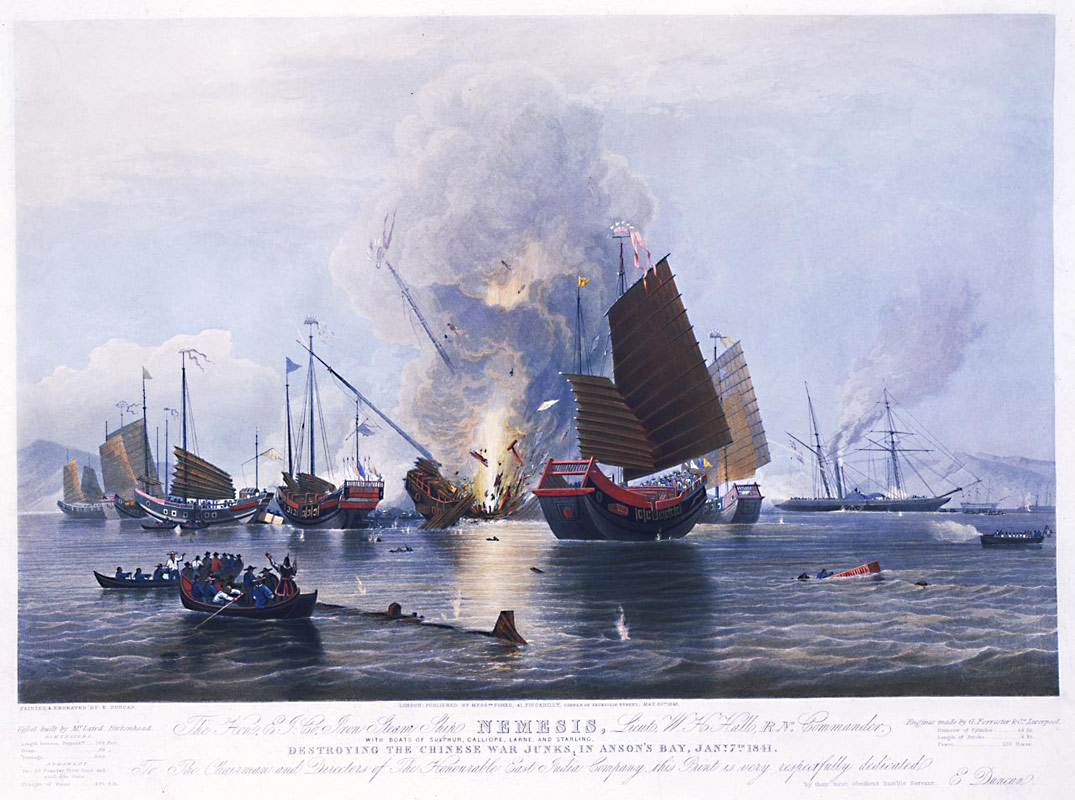
The early nineteenth century saw coastal defense gain importance in Tokugawa Japan as more and more foreign ships, sometimes equipped with heavy artillery far superior to what the Japanese could produce, intruded into coastal waters. The little attention given to maritime defenses by the shogunate, however, stood in no proportion to the massive advances in naval military technology and the military spending of the Western powers seeking entry to the country’s market.
Gunboats Intrude into Edo Bay
As trade with China had grown tremendously in volume, the United States sought to expand it via the Pacific route. Japan lies directly en route from the American West Coast to China, and a treaty allowing stopovers to resupply American ships while ensuring safe passage for trade ships and shipwrecked whalers was thought to benefit American commercial interests. In 1846 Commodore James Biddle entered Edo Bay to survey the Japanese position on these interests. He had been instructed to act peacefully and without coercion, and he retreated after bakufu officials conveyed that they had no intention of abandoning their existing foreign-trade policies.
Nonetheless, the consequences of his sudden visit were immense. The magistrate of Uraga, where Biddle’s two gunboats had anchored, recognized that “two ships had outgunned his shore fortifications by a factor of nine to one.” The realization that an unstoppable naval force had just sailed into the heart of Tokugawa Japan sent shockwaves through the bakufu. Just two days after Biddle’s gunboats were sent away, Abe Masahiro 阿部正弘 (1819–1857), the chief senior councilor of the bakufu, held a conference with the three magistrates of Edo to deliberate whether the “shell and repel order” should be reintroduced and how the bay’s maritime defenses could be improved. These consultations marked the beginning of wide-ranging reforms to coastal fortifications, their administration, and the bakufu’s policy for handling intruding foreign ships.
Besides Abe, the administration of Edo Bay defenses comprised a coastal defense officer (kaibō-gakari 海防掛), the magistrate of Uraga, and the four daimyō houses responsible for coastal defenses. Although officials briefly considered introducing Western-style warships and even assessed a sloop-style vessel, the immense cost of such an undertaking, the unassailable superiority of Western technology, and the wish for a more permanent solution convinced them that it would be more effective to overhaul and expand the existing system of land-based fortifications.
From Biddle’s departure in 1846 until the fifth month of 1850, the bakufu conducted a large-scale survey of possible improvements to existing fortifications and locations suitable for additional land-based coastal defenses. The report submitted in 1850 proposed relocation or improvement of existing positions and new fortifications in strategically important places. Apart from a few minor details, all proposed changes and additions were implemented. The number of cannons protecting Edo Bay rose 2.5-fold, from 40 in 1846 to 99 when Commodore Perry entered the bay in 1853. The reforms effectively turned the Strait of Uraga into a heavily fortified guchi—a “gateway”—designed in theory to control access to the capital.
Japanese officials were well aware of the military gap between Japan and the West, however, and Edo Bay’s defensive policy is better described as avoidance of confrontation than the repelling of adversaries. This is evident in the decision not to reintroduce the “shell and repel” order. Western naval supremacy had become so tremendous that officials instead decided to exercise utmost care in dealing with intruding ships, as provoking a naval war could devastate Tokugawa Japan.
The mismatch between this policy of caution and coastal structures designed to forcefully restrict access to Japanese waters made it impossible for the bakufu to enforce its sovereignty. American gunboats could effectively navigate Edo Bay at will, making a last line of defense necessary if Edo itself was to receive any protection at all.
The Shinagawa Batteries as a Last Line of Defense
With the acquisition of California, establishing a trade route between the American West Coast and China became more important to the United States. This furthered the desire for an agreement with Japan. The rich coal reserves of the Tokugawa state made Japanese ports attractive stopover stations able to supply coal for newly constructed steamships. Against this background, in 1853 a squadron of four gunboats led by Commodore Matthew Perry entered Edo Bay to secure a treaty that would suit American interests in Japan.
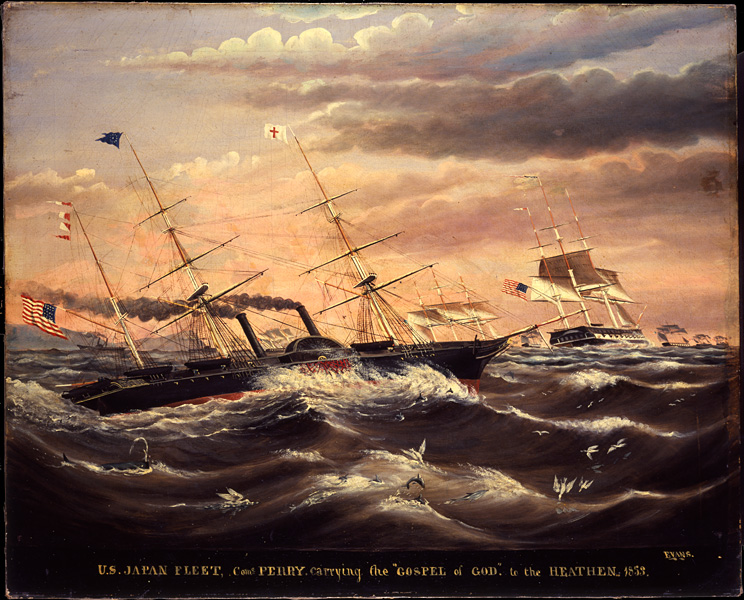
The official narrative of Perry’s expedition (1856) captures how, aware of American naval supremacy, the shogunate adhered to its policy of no longer shelling intruding ships in order to avoid provoking an unwinnable war:
The entrance to the bay seemed well fortified, and the hills and projecting headlands of Sagami were formidable with forts, the guns of which, however, were silent, notwithstanding the threatening entrance of the strange ships.
Having passed the heavily fortified “gateway” of the Uraga Strait without resistance, the inner bay was vulnerable to American gunboats. Although separated by only a few years, Perry’s assessment of maritime defenses inside Edo Bay reads radically differently from Alcock’s description of an “unattackable” capital:
As the boats approached the shores there was a good view of the fortifications, which did not seem to be of a very formidable character. Their construction did not exhibit much strength or art. Their position and armament were such as to expose them to an easy assault; their parapets were in earthwork, while many of the buildings, the barracks and magazines, appeared to be of wood. They mounted but few guns, and those of small calibre, while their embrasures were so wide that the cannon were greatly exposed.
This American evaluation puts the defensive reforms following the “Biddle-shock” into perspective. Perry judged the fortifications to “not exhibit much strength or art,” and even found them “in an unfinished state, and in progress of construction or alteration.” Though the combined number of guns on Perry’s four warships was lower than the armament of the gunboats Biddle had brought into the bay, they still commanded firepower far superior to each bakufu position.
The coastal fortifications had been overhauled, but they remained an inadequate response to technologically advanced American warships. Defending the bay would have meant certain defeat, and so Perry’s squadron was de facto free to navigate it at will. This further escalated the bakufu’s powerlessness: the most vulnerable part of Edo Bay—the capital—was in theory exposed to foreign gunboats.
This constellation becomes especially clear in the movement of the American expedition and the bakufu’s reaction. While anchored in Uraga Bay, Perry sent one ship in the direction of the capital to pressure the authorities “to give a more favorable answer to his demands.” A bakufu official promptly boarded the flagship to announce that a letter with Perry’s demands would likely be sent to Edo the next day. Both sides recognized Japanese vulnerability: Americans used it to pressure the shogunate, which immediately made concessions to fend off the perceived threat.
Even after forcing the bakufu to ceremoniously accept the letter from the president of the United States demanding an opening of Japanese ports, and announcing that he would return the following year with a larger fleet, Perry maneuvered his ships still closer to the capital. He reasoned that employing so large a force “in so near a neighborhood to the capital” would influence the government and prompt more favorable consideration of the president’s letter.
American pressure to open Japanese ports indicated commercial rather than hegemonial interests, but the sight of newly developed steam-powered gunboats equipped with technologically advanced heavy weaponry roaming Edo Bay, together with the promise of an even larger fleet the following spring, sent shockwaves through Tokugawa Japan. After Perry’s departure, Abe Masahiro presented President Fillmore’s letter to several daimyō and asked how to proceed. Opinions were too diverse for a foreign-policy consensus, but the decision to fortify Edo Bay by erecting eleven offshore artillery batteries immediately off the Shinagawa coast was reached rapidly. Construction began just two months after the departure of Perry’s “black ships.”
The “Western-style” fortified artificial islands were conceived by the shogunal administrator Egawa Hidetatsu 江川英龍 (1801–1855), based on translated European research materials on military technology. Fiscal constraints reduced the plan to six artillery batteries, but the Shinagawa Batteries still constituted the largest construction project undertaken by the bakufu since the construction of Edo Castle.

The project’s enormous scale and fiscal burden raise the question of why bakufu officials shifted from fortifying Edo Bay’s “gateway” at the Uraga Strait to the untested strategy of offshore artillery batteries after Perry’s arrival. The question is especially striking because officials planning Edo Bay defense immediately after Perry’s intrusion had briefly agreed on an “outer-harbor defense at the mouth of Uraga Bay,” before shifting to the “inner-harbor strategy” centered on the Shinagawa Batteries.
In her 2015 analysis of maritime security in Tokugawa Japan, Noell Wilson proposes a two-part explanation for this rejection of outer-harbor defenses. First, bakufu officials had gained a deeper understanding of American intentions. The demand for a treaty suggested economic interests rather than plans for “a full-scale invasion of Japan, as had been feared.” Fortifications could consequently focus on protecting the capital rather than the entire coastline. Second, Edo Bay’s unique topology mattered. As Alcock observed, the bay was shallow enough to obstruct very large warships from getting into firing range of the castle. The Shinagawa Batteries embraced this natural defense by adding obstacles between the shogun’s castle and adversary ships.
Wilson’s assessment convincingly explains why offshore batteries would have been favored, but it does not entirely uncover the motives behind the sudden strategic change. Despite extensive prior commitments to a gateway strategy at the Uraga Strait, the officials decided against further enhancement of those fortifications and instead pivoted to the costly strategy of deploying artillery batteries on artificial land.
Even after the gateway at Uraga had been heavily fortified following Biddle’s departure, the Tokugawa policy of not shelling intruding ships—out of fear of provoking an unwinnable war—remained unchanged. The bakufu had to stand by and watch heavily armed foreign gunboats roam freely through the bay, posing an existential threat to the capital. A gateway strategy inherently requires fortifications to enforce entry regulations by shelling ships denied entry; it was therefore unfit for Edo Bay, where Western naval supremacy forced the shogunate to pursue military passivity.
Offshore fortifications in Edo’s immediate vicinity instead embraced this defensive policy. As obstacles that physically prevented gunboats from approaching the capital, the Shinagawa Batteries offered a passive form of protection. Their proximity to the capital also meant that their firepower could be used militarily if a foreign gunboat attempted to besiege Edo after entering the bay unchecked. Fortifications at the mouth of the channel would simply have been too distant to assist in the capital’s defense.
Taking geographic peculiarities and American interests into account makes the bakufu’s costly shift to inner-harbor defense more comprehensible. Future research could test this proposition against primary sources and further investigate the reasoning behind the strategic shift in Edo Bay’s maritime defense.
References
- Alcock, Rutherford. The Capital of the Tycoon: A Narrative of a Three Years Residence in Japan. Vol. 1. London: Longman, Green, Longman, Roberts, and Green, 1863.
- Beasley, William G. “The Foreign Threat and the Opening of the Ports.” In vol. 5 of The Cambridge History of Japan, edited by Marius B. Jansen, 259–307. Cambridge University Press, 1989.
- Bolitho, Harold. “Abe Masahiro and the New Japan.” In The Bakufu in Japanese History, edited by Jeffrey P. Mass and William B. Hauser, 173–88. Stanford University Press, 1985.
- Hawks, Francis L., and Matthew C. Perry. Narrative of the Expedition of an American Squadron to the China Seas and Japan, Performed in the Years 1852, 1853 and 1854, under the Command of Commodore M. C. Perry, United States Navy, by Order of the Government of the United States. Vol. 1. New York: D. Appleton and Company, 1856.
- Howell, David L. “Foreign Encounters and Informal Diplomacy in Early Modern Japan.” Journal of Japanese Studies 40, no. 2 (2014): 295–327.
- Toby, Ronald P. “Reopening the Question of Sakoku: Diplomacy in the Legitimation of the Tokugawa Bakufu.” Journal of Japanese Studies 3, no. 2 (1977): 323–363.
- Tomikawa Takeshi 富川武史. “Shinagawa Odaiba no chikuzō to chiiki shakai” 品川台場の築造と地域社会. In Edowan bōbi to Shinagawa Odaiba 江戸湾防備と品川お台場, edited by Shinagawakuritsu Shinagawa Rekishikan 品川区立品川歴史館, 7–31. Iwata Shoin, 2014.
- Uematsu Toshihiro 上松俊弘. “Biddoru raikō to kaibō mondai” ビッドル来航と海防問題. Shirin 史林 85, no. 1 (2002): 64–87.
- Wilson, Noell. Defensive Positions: The Politics of Maritime Security in Tokugawa Japan. Harvard University Press, 2015.